
The High Fifteen Website Project
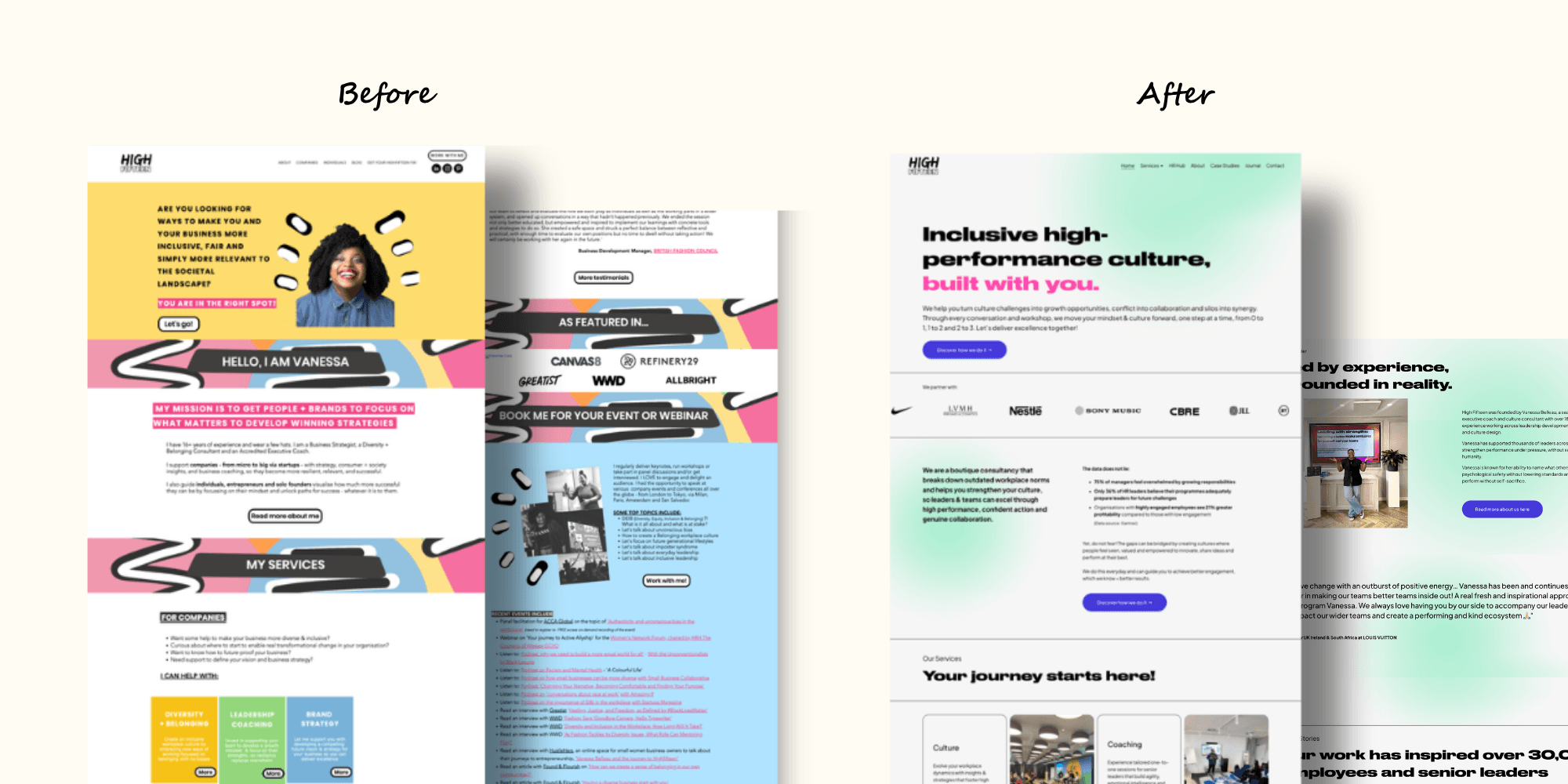
There's a specific kind of client I love working with. She's already good at what she does. She's been running her business for a while. She has real clients, real results, and a website that technically works.
She just can't stand looking at it anymore.
That's Vanessa.
Meet Vanessa
Vanessa is the founder of High Fifteen, an inclusive high-performance consultancy. She's an artist, a painter, a consultant and, by her own admission, someone who talks a lot. (She said it first. I'm just confirming it's a good thing.)
She'd built her first website herself on Wix years before we spoke. She described it as "a window." Somewhere for people to look if they wanted to.
But here's the thing about windows. If they're not clean, they're not doing their job.
"My website before was a window, but it was not clear. I needed to clean it."
The business had grown. The brand in her head had evolved into something richer and more specific. But the website? Still exactly where it had been three years earlier.
She absolutely had the skills to rebuild it herself colour, design, and visual thinking are very much her world. But she knew that wasn't actually what she needed.
"It's always great to actually discover how somebody else sees your brand and sees you. I wanted to work with an expert because I wanted that outside perspective."
So she started looking. And here's where it gets interesting.
What She Was Actually Looking For
Vanessa is direct. She knew exactly what she needed — not just in a website, but in the person she'd be building it with.
"I needed somebody who had emotional intelligence."
Not just design skills. Not just a clean Squarespace build. Emotional intelligence. Because she'd noticed something about the web design world: a lot of people can technically do the job. The question is whether they actually understand what you do, who you're trying to reach, and why it matters.
"A lot of people are around the ego matrix. They are not about the depth."
She also needed flexibility. Her business pivots, it evolves, she changes her mind and she didn't want to be locked into someone else's vision where she'd need to call them back every time she wanted to change a line of text. She wanted to look beyond the same names circulating in her network.
But the thing she knew most clearly was this: she needed someone who would challenge her.
"I needed someone who was able to cut through all the noise and make things very simple."
She had no shortage of ideas. What she needed was someone who could see through all of them.
The Moment She Decided
Before we'd even had a proper conversation, something had already landed.
She'd received my onboarding document. And something about it made her think: okay.
"You sent me an onboarding document, and I was just like, yes."
Then we got on a call. She told me she needed to be challenged. She needed someone who would actually say no to her when it made sense.
And then, in that same conversation, I did exactly that.
"We were chatting about something and you said, no, you know. And you actually demonstrated it. And I was just like, God, this woman sees me."
That was it. Not the portfolio. Not the credentials. The moment she realised this was going to be a partnership, not a transaction.
What the Process Actually Looked Like
Here's what Vanessa thought she was signing up for: a new website that looked better and worked properly.
Here's what actually happened: she got clear on her business in a way she hadn't been before.
The process involved a lot of questions. Patient ones, she said. Important ones. Not surface-level "what are your brand colours" questions - the kind that make you stop mid-sentence and actually think about why you're doing what you're doing, and who you're doing it for.
"The whole journey of 'what page do we want, what do we want to put on the page' and then you telling me, Vanessa, what are you saying? This doesn't make sense. Come on, dig deeper -enabled me to reconnect with what I do on a different level."
The hard part of this process, for any business owner, is that your website is personal. It's yours. It carries everything you've built. And yet for it to actually work, you have to step outside yourself and see it the way a stranger would - someone landing on it cold, deciding in thirty seconds whether to stay or leave.
"When you do a website, you need to put yourself in the shoes of the person who is going to actually read the website and engage with it. Even though it's your baby, it's not really. You have to let that go."
That's the work. And that's why having someone outside of your own head matters.
After It Went Live
The website launched. Something shifted immediately.
"It's so easy for me to explain what I do now. If somebody asks, 'what can I expect?' I just link the page or do a screenshot of that little bit because we covered it."
She started using the journal section as a resource for clients — something she'd never done with the old site. The feedback was overwhelmingly positive. And then this happened:
"Other business owners have told me, 'Vanessa, we're using your website as a template.' A few people have said that."
Her first reaction was nerves. She'd put so much of her thinking on there. What if people just took it? But then something shifted.
"It actually enabled me to let go, which I realised was a beautiful thing. That's what I do. That's what I do at High Fifteen. My difference is what I bring."
The website was good enough that other businesses referenced it as a benchmark.
The Part That Mattered Most
You know how some people brush off compliments about their website? Not out of modesty — but because they can see the gap between what the other person is responding to and what the business has actually become?
That was Vanessa.
"People would tell me, 'your website is so good.' And I'd be like... I was not believing them."
That's gone now.
"Now when people say 'I love your website,' I'm like, yes. I believe you."
And this, which she said towards the end of our conversation and which I think is the most important thing in this entire post:
"I'm very proud of what I do. And the confidence it has given me in talking about my business, in sharing my work - I don't overthink it anymore. Overthinking has got a cost, an emotional cost. I don't have that cost anymore. It's only a reward now."
Overthinking has an emotional cost and the website removed that cost. I'm putting that on a sticky note somewhere!
What She Said She Actually Got Out of It
At the end of our conversation I asked Vanessa what she'd really walked away with. She didn't hesitate.
"This pushed me really to be extra clear. I didn't even have my own clarity fully before. The cost of clarity - that's what I would say I got."
She paid for a website. Business clarity came along for the ride.
That's what happens when the process isn't just about making things look better. It's about making things make sense.
One Last Thing
Throughout our whole conversation, Vanessa kept coming back to one word. Not design. Not results. Not even clarity.
Partnership.
It came up again and again, unprompted. Not vendor and client. Not expert and student. Partners - from the very first call.
"From the get-go, we were partners. And I love that."
She needed someone who would see her. Push back when it mattered. Ask the hard questions without making it feel like an interrogation. Someone who cared about the quality of the work for its own sake - not just to add another project to the portfolio.
"There was no ego. I find that very refreshing, and this is exactly what I needed."
That's what she kept coming back to. Not the design. Not the results. Just that.
If your website technically works but no longer feels like you - if you're brushing off compliments because you can see the gap between where the site is and where the business is - that's exactly the kind of disconnect I help with.
Not just better design. Clarity. A process that helps you reconnect with your own business and come out the other side with a site you're actually proud to share.
This post is based on a recorded interview conducted almost a year after the website launched.